Daniel Goldhagen says yes. Mark Riebling, more persuasively, says no. You can read it now or be like the other slobs and read it in {link http://www.nationalreview.com/ National Review}} three weeks from now.
Nov 202002
Daniel Goldhagen says yes. Mark Riebling, more persuasively, says no. You can read it now or be like the other slobs and read it in {link http://www.nationalreview.com/ National Review}} three weeks from now.
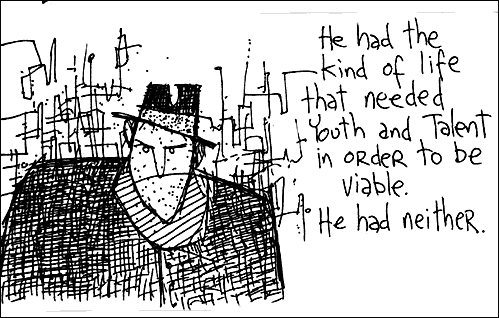
Hugh MacLeod has at least one. (Link from Objectionable Content, where Jim shows a few of his favorites.)
I cannot follow a certain kind of historical argument against the war, which runs like this:
We supported Saddam when he was fighting against Iran. We supported the mujahedin when they were fighting the Russians against Afghanistan. Therefore we are hypocritical, or wrong, or both, to war on them now.
Our past support for both the Taliban and Saddam has been exaggerated, but let’s leave the facts aside and consider the structure of this argument. What, exactly, obliges us always to support someone we have supported in the past? The British fought against us in the War of 1812; are they hypocrites to ally themselves with us now?
Or perhaps you don’t care for reductios. Very well: the Russians were our allies in World War II and our enemies after the war: same government, different circumstances. The shift was neither hypocritical nor immoral nor foolish. The Taliban were useful to us when they were fighting the Russians. So was Saddam during the Iran-Iraq War, when Khomeini was a bigger nuisance. The Russians leave, Khomeini dies, things change.
One can argue that supporting Saddam was a bad idea then. One can argue that removing Saddam is a bad idea now. One cannot argue that the two have anything to do with each other.
On a new TV show “a bunch of peace-sign-painting hippies are . . . the bad guys,” and Professor Reynolds posits cultural change: “Hippies never used to be the bad guys.”
I’ve finally found the last man on earth who hasn’t seen Dirty Harry.
You hate poetry, like all self-respecting people who remember the English teacher’s pet in high school, the girl who liked rainbows and Christina Rossetti. As Marianne Moore said, “I, too, dislike it.”
Besides, most of the stuff you had to read was lousy. If your education in lyric poetry was anything like mine, it consisted largely of Milton, Keats and Shelley and a swath of second-rate Elizabethans like Sidney and Spenser. The Norton Anthology of English Literature is an undifferentiated and indigestible mass of mediocrity.
That’s why you need this top five list. There are only five because if I posted ten you wouldn’t read any. They are all under 30 lines long because the attention required to read great poetry properly is difficult to sustain. You never had to read them in school. You probably never read them at all. And they’re far better than anything you did have to read. (Full Disclosure: I wouldn’t know most of these poems myself if not for the great poet and critic Yvor Winters, who formed my taste.)
To Heaven, Ben Jonson (1572-1637). This is a Christian poem that one need not be a Christian to appreciate. Jonson addresses the real issue, which is that in middle age people often grow tired of life; Donne, with his neurotic and overdramatized fear of death, seems phony by comparison.
“As imperceptibly as grief,” Emily Dickinson (1830-1886). Only Stevens, in The Snow Man, which I recommend to anyone who thinks vers libre is a contradiction, and in the fourth and eighth stanzas of Sunday Morning, another great poem but too long to make the list, conveys nature’s alien majesty nearly as effectively. This poem also exploits off-rhyme more brilliantly than any poem ever written in English.
“My spirit will not haunt the mound,” Thomas Hardy (1840-1928). Hardy speaking from beyond the grave again, which he does in his poetry quite often. Note the placement of the caesuras in the last line of each stanza. First between the third and fourth syllables, then between the first and second, and finally between the second and third, resolves the poem the way a musical note resolves a chord. Hardy, Wallace Stevens and Thomas Campion are the best metrists in English.
Exhortation, Louise Bogan (1897-1970). The necessity of hatred.
To the Reader, J.V. Cunningham (1911-1985). On one level this poem is about textual scholarship; on another, about the relationship between experience and the wisdom that can be drawn from it.
I’ve been banned by the government of China! I have! Alas, it isn’t because Jiang Zemin decided my imperialist running dog propaganda was too dangerous for the masses to read. They got themselves a list of authorized sites, see, and my friends and I aren’t on it, and you and your friends aren’t either. But don’t let me keep you from enjoying that frisson of dissidence while it lasts. Oddly, the official Chinese Government site is reported as inaccessible in China. A prize, or something, to the first person who finds a site that isn’t blocked in China. (Link from OxBlog.)
(Update: The Declarer, Floyd McWilliams, comments that he was in an Internet cafe in China last week and pulled up The Washington Post, Drudge and Instapundit, all of which are reported inaccessible by the Harvard site. The apparently universal faith that if software returns results then the results must be correct is touching. Really.)
(Further Update: Looks like Harvard ironed out a few kinks. I’m now reported as accessible in China, and so is blogspot, and so, I suspect, is everyone else who was so pleased about being banned. Which indicates that I was wrong, and that they do, in fact, maintain a list of banned domains rather than authorized ones.)
Type 2 Libertarian Floyd McWilliams runs an excellent site called The Declarer, and I would blogroll him even if he wasn’t a bridge geek. He is now in China and has interesting things to say about it.
Sasha “La Blogatrice” is now housing most of the Dodgeblog boys (although MommaBear has splintered). Three more great reasons to read her. Do it now.
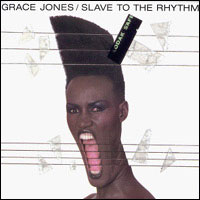 Agenda Bender posts a righteous tribute to that unique 80s classic, the mother of all remix albums, Grace Jones’s Slave to the Rhythm.
It’s easy to forget what pop music was like in 1985. Punk had long since killed off AOR, only to choke on its own vomit (or maybe someone else’s vomit; the inquest was never clear). The huge albums of the year were the Miami Vice soundtrack, Brothers in Arms by Dire Straits and No Jacket Required by that short bald guy who used to be in Genesis. The critical favorites were mopey bands like Hsker D, Sonic Youth and R.E.M. before they learned to play their instruments. And then along come Trevor Horn and Steve Lipson, with beats, and crystalline production on which you can hear the triangle on the 64th track, and trancy spoken-word raps like, “Rhythm is both the song’s manacle and its demonic charge…it is the original breath, it is the whisper of unremitting demand…” And you don’t have to be gay to appreciate, “That night, [Grace] was singing her hit song, ‘I Need a Man,’ to a room full of shrieking gay bobby soxers…the ambiguity was that she herself looked like a man…a man, singing ‘I need a man,’ to a bunch of men.”
Horn and Lipson made many memorable records on their imprint, Zang Tuum Tumb Records, even better ones, like Propaganda’s A Secret Wish and Frankie Goes to Hollywood’s Liverpool. But Slave to the Rhythm was first and still fabulous.